Gestational Age & Infant Survival
Modern neonatal medicine has changed what survival at very early gestational ages can mean. This page follows U.S. infant survival week by week—from the earliest documented survivor through full term and postterm—with the underlying measures and sources shown plainly.
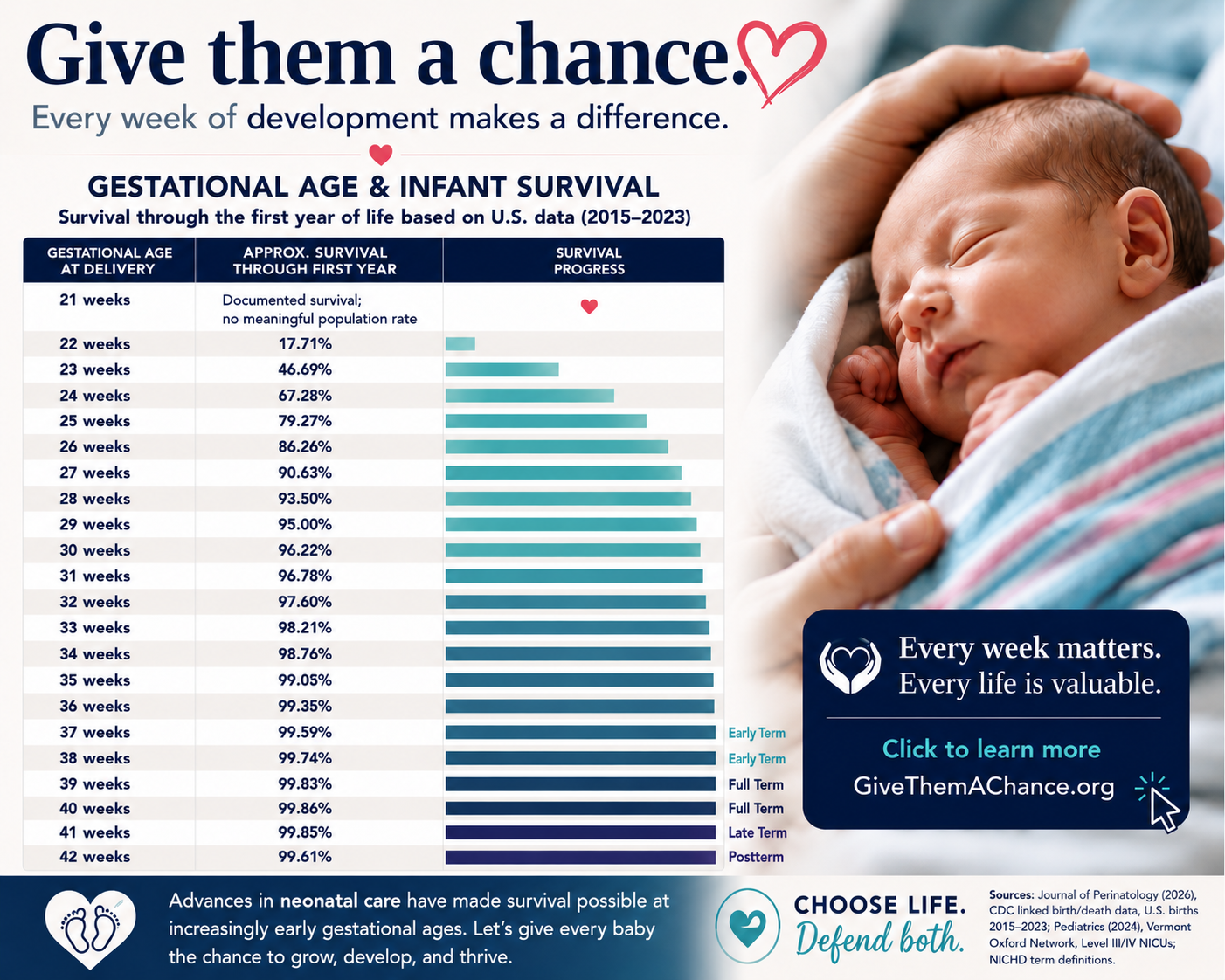
Survival by Completed Week of Gestation
Each row represents one completed week—no grouped ranges. For weeks 22–42, the percentage is approximate U.S. survival through the first year of life, calculated from gestational-age-specific infant mortality in the national linked birth/death dataset. Week 21 is shown separately because survival has been documented, but a meaningful population rate is not available.
| Gestational age at delivery | Approx. survival through first year |
|---|---|
| 21 weeksDocumented survival | Exceptional documented survival; no meaningful U.S. population survival rate is available for this gestational age. |
| 22 weeksExtremely preterm | 17.71% |
| 23 weeksExtremely preterm | 46.69% |
| 24 weeksExtremely preterm | 67.28% |
| 25 weeksExtremely preterm | 79.27% |
| 26 weeksExtremely preterm | 86.26% |
| 27 weeksExtremely preterm | 90.63% |
| 28 weeksVery preterm | 93.50% |
| 29 weeksVery preterm | 95.00% |
| 30 weeksVery preterm | 96.22% |
| 31 weeksVery preterm | 96.78% |
| 32 weeksModerate preterm | 97.60% |
| 33 weeksModerate preterm | 98.21% |
| 34 weeksLate preterm | 98.76% |
| 35 weeksLate preterm | 99.08% |
| 36 weeksLate preterm | 99.35% |
| 37 weeksEarly term | 99.59% |
| 38 weeksEarly term | 99.74% |
| 39 weeksFull term | 99.83% |
| 40 weeksFull term | 99.86% |
| 41 weeksLate term | 99.85% |
| 42 weeksPostterm | 99.61% |
Modern Level III/IV NICU survival to hospital discharge
A separate 2024 Pediatrics study examined 22,953 infants at 636 U.S. hospitals with Level III or IV NICUs from 2020–2022. Because its outcome is survival to hospital discharge, these figures should not be substituted directly into the first-year-survival table.
Exactly 21 Weeks Gestation
Guinness World Records identifies Nash Keen of Iowa as the most premature baby to survive. He was born July 5, 2024 at exactly 21 weeks gestation, weighing 285 grams (10 ounces). Guinness reported in July 2026 that he had reached his second birthday.
An individual documented survival does not establish a population survival rate. Outcomes at the earliest gestational ages depend on many clinical and circumstantial factors, including the infant's condition, treatment decisions, and the capabilities of the hospital.
Why the Numbers Change So Rapidly
Gestational age matters
At the earliest gestational ages, organ systems are still undergoing rapid development. Additional time before delivery is associated with substantial changes in pulmonary, neurological, cardiovascular, gastrointestinal, immune, and temperature-regulation capacity.
Medical care matters
Outcomes also reflect whether active treatment is initiated and whether delivery occurs at a center equipped for extremely premature infants. Specialized neonatal care has materially changed survival at the earliest gestational ages.
What “Term” Means
“Term” is not a single five-week category. NIH/NICHD materials reflect the obstetric definitions adopted by the American College of Obstetricians and Gynecologists and the Society for Maternal-Fetal Medicine.
Give Them a Chance
The image below summarizes the same week-by-week first-year-survival series and separately identifies the modern NICU survival-to-discharge figures.

Sources & Methodology
The page deliberately distinguishes national first-year-survival estimates from specialized NICU survival-to-discharge data. Those measures answer different questions.
“U.S. infant mortality, by gestational age, 2015–2023.” Uses CDC WONDER linked birth/infant death records and reports gestational-age-specific infant mortality from 22 through 42 weeks. Read the study
Federal linked birth and death certificate data used for population-level infant mortality analysis. CDC WONDER
“Survival of Infants Born at 22 to 25 Weeks’ Gestation Receiving Care in the NICU: 2020–2022.” Includes 22,953 infants at 636 U.S. hospitals with Level III or IV NICUs and reports survival to hospital discharge by week. Read the study
Documents Nash Keen’s birth at exactly 21 weeks gestation on July 5, 2024, and subsequent survival. View the record
NIH educational material defining early term, full term, late term, and postterm pregnancy. View NICHD guidance